
Mini Jeep ATV 4x4 - Willys Jeep Mini Replica -1941 (Coolster)
One of the coolest Toys you can buy in 2025 …. the Mini Jeep this amazing little ATV sit in between 1/2 and 1/3 scale model of a 1941 Army Jeep. This 125cc single cylinder can take two adults across a vast array of terrain at speeds of upto 40mph with an estimate MPG of 80

1941 WIllys Style Coolster Mini Jeep
Mini Jeep ATV 4x4 Style Willys 1941 1/2 Scale Petrol 125cc 3 Speed
What is a Mini Jeep ?
These amazing vehicles sits at just over 1:3 scale, they are fully working petrol driven models of a WWII Jeep. Able to fit two adults quite comfortably, built for off-road use using Coil spring suspension.
Watch our Mini Review by clicking on the above like (and please leave a like !)
What engine does a Mini Jeep have ?
They have either a 125cc and 150cc engines
Capable of speeds up to 37 mph.
4 Stroke single cylinder.
3 Speed forward 1 Reverse
How fast does a mini jeep go ? 37 mph
Driving Review :
lets start out with the fun factor which is 10 out of 10 !
Having a little petrol engine under the hood, linked to a 3 speed forward 1 reverse semi -automatic (so no clutch to worry about) gives you the options of using a very low 1st gear for off-roading in deep mud, hill climbing etc. Gear 2 is still perfect for off-roading while still giving the torque required to plough through most terrains.
Moving into 3rd gear gives you the top speed of 37.5mph, when using the amazing little vehicle on the road. Off Course it mainly geared for off roading, so those deep knobbly tyres will make road use nosier, and in the wet (on tarmac) caution should be taken and it does make it a little slippy !
But the great thing is you could purchase another set of wheels to use road tyres when not plugging through rough terrain.
The Steering wheel is adjustable in reach so most adults (I’m just under 6ft) can get comfortable behind the wheel.
Let’s talk about on the road first …..

Mini jeep bonnet

Mini jeep grill
It comes with front and rear lights, indicators, rear reverse light, horn, seatbelts, additional fuel tank, spare wheel, windscreen, handbrake and disc brakes.
So it has nearly all the necessary Road Legal equipment bar :
A fog light
Hazard warning flash
Roll over cadge.
And if you’re in the U.K a MPH speedometer (Kmh only, and this is highly inaccurate, so would be best to purchase a GPS Speedometer)
Also it has an a optional Speed limited for those younger drivers out there
In some states these can be road legally, and the 37.5mph top speed comes in handy to keep up with traffic.
As there is no sound proofing, a helmet makes driving this on the road a lot more comfortable and it can get noisy, but that’s part of the fun !
Off-Road those two first gears really do make getting through most terrains very easy, the knobbly tires get stuck into the deepest of mud conditions and seem to make the whole experience very exciting, and certainly brings on many smiles per mile !
Coolster is owned by an American based Company who distribute these mini ATV / Golf carts
Mini Willys Style Jeep Specification :
1 : 2 Scale
Mini Jeep engine 125cc Engine 4 stroke, 154fm, XinYuan
Features : Reverse light, Neutral light, Horn, indicators (with audio alarm) reverse light, Spare wheel, Army style Gas Can,
Transmission 3 speed with reverse
Drive Type : Chain : 530H 153l
EPA approved Carb
Petrol 1.06 gal
Tire size : 18x7-8
Oil capacity : 0.8L Air cooled motorcycle oil with clutch additive
Battery 12v 9A
Coil Suspension Front / Rear : Dual Arms with swingarm rear

Jeep Mini Willy’s Style in forest

Mini Willy’s style jeep WWIi
The windscreen does fold down, so again this makes getting through trees, and branches a lot easier as there’s no risk of damage
Mini Jeep buying tips
These do not come completely fully built out of the box, (unless your buying from a dealer) like Coolster.
So if your buying new or 2nd hand this is what you need to check :
Front Suspension strut bolts are tight
The exhaust bracket and exhaust bolts are tightened, whilst we are on this subject check the exhaust manifold bolts are tight
Check wheel Hub bolts are tight
Check wheel nuts (although overtightening can strip the thread)
Check steering rack bolts are tight
Check steering ball joints bolts are tight
Check handbrake works
Check Disc brake are functioning correctly
Check steering column, and steering wheel bolts
Check all suspension bolts,
Check the fuel line is secure (as clips are not very strong)
Check Rear axle bearings are greased (there is a grease nipple) but apparently they come dry
Check chain is lubricated
Check body security as the bolts can and do rust
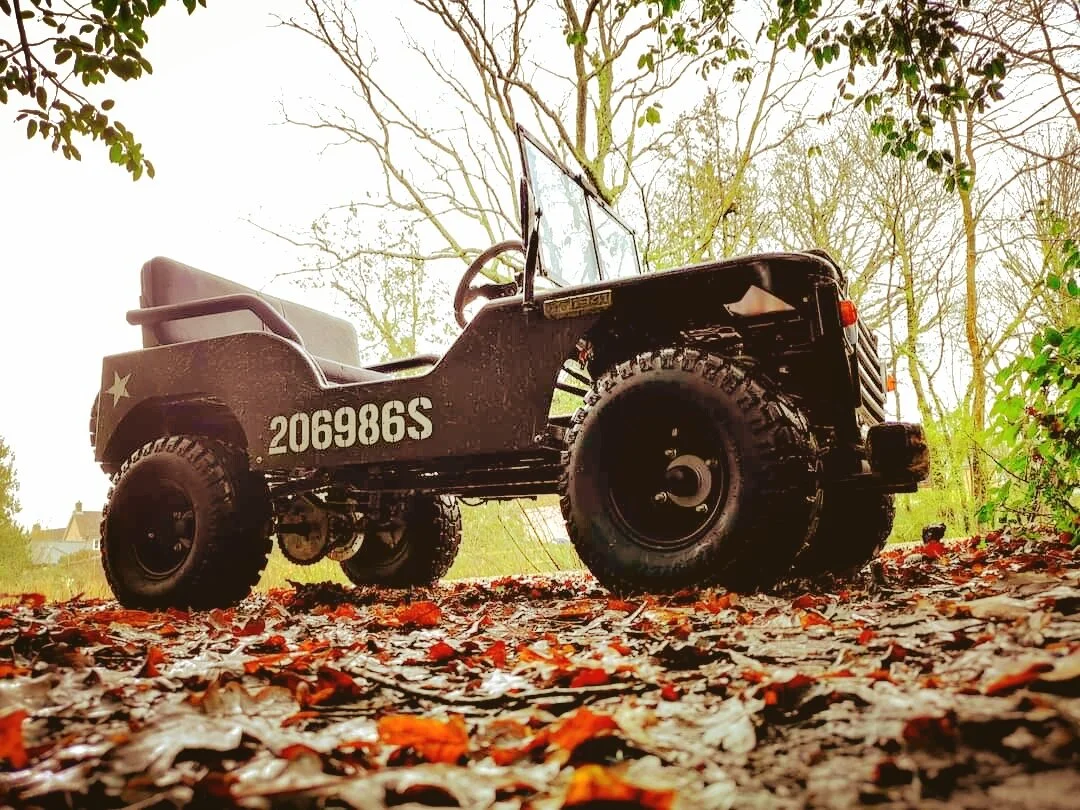
Mini jeep - Coolster

Jeep Dashboard

Mini jeep engine

Mini Jeep gross weight 330.7 / 363.8lbs
Mini Jeep Weight capacity 264.6lbs
Disc Brakes front rear
Electric start with Key
Fully working lights, indicators, horn and speedometer
Speed limiter function (can be added)
Shock Absorbers
Fold down windscreen
Parking Brake
Leather Seats
Safety Belt
Spare Wheel
Spare Fuel Tank

1941 style mini jeep

Mini jeep dashboard
Mini Jeep Dimensions
Width :
950mm
Height :
950mm
Length :
1950 mm
Ground Clearance :
9.84 inches

Army Mini Jeep - Spare wheel

Army Style Mini Jeep 1941
Future Upgrades
To Install a bumper mounted winch
4” Jeep Spot lights
K&N Air filter
Snorkle
GPS Speedometer and Tachometer
Fuse Box
D Rings on bumper

Jeep Army style - Mini Jeep 125cc

Jeep Army style - Mini Jeep 125cc
To find out more fun Future Facts by clicking our Blogs below……….!!! Please Share …..
Ghostbuster - Ecto 1
https://www.sandstoneproductions.co.uk/blogtothefuture/2021/3/31/ghostbusters-ecto-1
Cars of Back to the Future
https://www.sandstoneproductions.co.uk/blogtothefuture/2021/2/10/the-cars-of-back-to-the-future-55-
Back to the Future Fashion
https://www.sandstoneproductions.co.uk/blogtothefuture/2021/2/19/back-to-the-future-fashion-te2yx
Ariel Leader
https://www.sandstoneproductions.co.uk/blogtothefuture/2021/2/17/ariel-leader
Back to the Future - Hill Valley History
https://www.sandstoneproductions.co.uk/blogtothefuture/2021/2/2/hill-valley-history-jxrr4
Back to the Future Gadgets and Trends we have in 2021
Doc Browns Biography and the History of his DeLorean Time Machine
Marty McFly Biography also featuring Biff, George, Jennifer, Loranine
Back to the Future - Hill Valley History
https://www.sandstoneproductions.co.uk/blogtothefuture/2021/2/2/hill-valley-history
Back to the Future - Detailed storyline
Back to the Future - How to generate 1.21 Giggawatts / Jiggawatts with Mr Fusion
What is a Fat Bike ? And where did the idea of Fat Bikes come from ?
https://www.sandstoneproductions.co.uk/blogtothefuture/2021/1/10/fat-bike-what-is-a-fat-bike-history
The Time Paradox explained - Back to the Future
The Sinclair C5
https://www.sandstoneproductions.co.uk/blogtothefuture/2021/1/9/sinclair-c5-
Mini Jeep Mini Review
https://www.sandstoneproductions.co.uk/blogtothefuture/minicoolsterjeepreview
Hoverboards - Back to the Future
https://www.sandstoneproductions.co.uk/blogtothefuture/2020/12/13/hoverboards-
How does the Time Machine work - Back to the Future
https://www.sandstoneproductions.co.uk/blogtothefuture/2020/11/22/how-does-the-time-machine-work
The DeLorean Motor Company - What did it fail ? Or did it ?
https://www.sandstoneproductions.co.uk/blogtothefuture/2020/11/22/whydiddeloreanmotorcompanyfail
The DeLorean Motor Company - History
https://www.sandstoneproductions.co.uk/blogtothefuture/2020/11/22/deloreanmotorcompany
The Flux Capacitor - Back to the Future
https://www.sandstoneproductions.co.uk/blogtothefuture/fluxcapacitor
Is Time Travel Possible ? And what would it take ? Back to the Future
https://www.sandstoneproductions.co.uk/blogtothefuture/istimetravelpossible

Great Scott !!! What an 'Amazing Google Review' for Sandstone Productions !!!
OMG !!! 'Check Out' our latest review... !!!!
I'm so ecstatic receiving feedback this positive !!!
It makes all the time and effort put into the DeLorean so worth while, especially sparking up passion like this !! ................
" During my stay in the UK, my family surprised me with an unforgettable moment in the form of Mark and his breathtaking
DeLorean stopping by.
What can I say that hasn't already been said by the dozens of others that Mark has touched with his creation?
As a BTTF fan, there is no cooler experience to be had!
There is an immeasurable amount of painstaking detail lovingly put into this masterpiece of a restoration.
Every single detail, be it a weld, a cable, a button or a prop are exactly as they should be, making this a jaw dropping experience for any mega fan.
On top of the car itself, Mark is one of the nicest and most passionate folks you'll ever meet.
His love for the franchise, his project and the joy he brings to those that have the pleasure of seeing his car is second to none!
We chatted for quite a while about our mutual love of film, his many ongoing vehicular projects (stay tuned!!!) and just how monumental an occasion this was for me and my wife, who bonded over the films early on in our relationship.
Quite literally, this was an adult-aged core memory moment that
I'll be reminiscent about for the rest of my life.
THIS WAS HEAVY!!!
Thank you Mark for sharing your slice of joy with the world !!! "
Watch our story here !!!
https://youtu.be/HxHHzMvk4Tk
Great Scott !
What an 'Amazing Google Review' for Sandstone Productions
OMG !!! 'Check Out' our latest review... !!!!
I'm so ecstatic receiving feedback this positive !!!
It makes all the time and effort put into the DeLorean so worth while, especially sparking up passion like this !! ................
" During my stay in the UK, my family surprised me with an unforgettable moment in the form of Mark and his breathtaking
DeLorean stopping by.
What can I say that hasn't already been said by the dozens of others that Mark has touched with his creation?
As a BTTF fan, there is no cooler experience to be had!
There is an immeasurable amount of painstaking detail lovingly put into this masterpiece of a restoration.


Every single detail, be it a weld, a cable, a button or a prop are exactly as they should be, making this a jaw dropping experience for any mega fan.
On top of the car itself, Mark is one of the nicest and most passionate folks you'll ever meet.
His love for the franchise, his project and the joy he brings to those that have the pleasure of seeing his car is second to none!
We chatted for quite a while about our mutual love of film, his many ongoing vehicular projects (stay tuned!!!) and just how monumental an occasion this was for me and my wife, who bonded over the films early on in our relationship.
Quite literally, this was an adult-aged core memory moment that
I'll be reminiscent about for the rest of my life.
THIS WAS HEAVY!!!
Thank you Mark for sharing your slice of joy with the world !!! "
Watch our story here !!!
https://www.youtube.com/watch?v=HxHHzMvk4Tk&t=41s
www.sandstoneproductions.co.uk
#delorean #deloreantimemachine #deloreandmc12 #backtothefuture #martymcfly #delorean #bttf #s #docbrown #michaeljfox #dmc #deloreantimemachine #timemachine #christopherlloyd #fluxcapacitor #hillvalley #outatime #timetravel #mcfly #movie #hoverboard #movies #deloreandmc #greatscott #backintime #art #backtothefuturetrilogy #bifftannen #bhfyp #timemachine #mcfly #marty #docbrown #greatscott #fluxcapacitor #christopherlloyd #backtothefuture2 #backtothefuture1 #backtothefuture3 #dmc12 #deloreantimemachine #deloreandmc12 #BTTF #bttf1 #bttf2 #bttf3 #time #timecircuits #docbrown #1980s #popculture #props #flux #fluxbands #glow #giggawatts #jiggawatts #1.21 #power #mrfusion #carsofbacktothefuture #cars #bttfcars #backtothefuturecar #timemachineoperatorsguide #howitworks #howthetimemachineworks #google #googlereview #googlereviewsmatter #googlereviews5star #5star #feedback #positivefeedback #Sandstone #sandstoneproductions

Top Gear - The DMC-12 40th Birthday - On Road and Track DeLorean Review
Top Gear DeLorean’s 40th Birthday Road and Track Review with Chris Harris - Series 31 Eposide 4
🚗 DeLorean's 40th Anniversary on Top Gear
The report, which aired in 2021 (40 years after the car's launch), featured presenter Chris Harris investigating the "stranger than fiction" story of the DeLorean.
Focus: The segment covered the tumultuous history of John Z. DeLorean and his vision for the gull-winged, stainless steel sports car.
Northern Ireland Tribute: Harris notably paid tribute to Northern Ireland's role in the car's manufacture, including scenes of him driving the car around Belfast's Titanic Quarter, where the factory was located.
The Back to the Future Legacy: It also covered the car's instant and enduring iconic status due to its starring role as the time machine in the Back to the Future trilogy.
Top Gear reviews the DeLorean 40 years on …..
Chris Harris investigates the stranger than fiction story of the time-travelling DMC DeLorean in this episode.
The story of John Z DeLorean and his vision of building his own Supercar has certainly been a roller coaster ride and one that still to this day could not be replicated.

The DMC-12 DeLorean’s 40th Birthday
Follow our Hashtags
#delorean #dmc #dmc12 #delorean40th #deloreans40thbirthday #40yearsofdelorean #topgear #topgeardelorean
Willys Jeep Mini Replica -1941 (Coolster)
One of the coolest Toys you can buy in 2025 …. the Mini Jeep this amazing little ATV sit in between 1/2 and 1/3 scale model of a 1941 Army Jeep. This 125cc single cylinder can take two adults across a vast array of terrain at speeds of upto 40mph with an estimate MPG of 80
1941 WIllys Style Coolster Mini Jeep
What is a Mini JEEP ?
These amazing vehicles sits at just over 1:3 scale, they are fully working petrol driven models of a WWII Jeep. Able to fit two adults quite comfortably, built for off-road use using Coil spring suspension.
Watch our Mini Review by clicking on the above like (and please leave a like !)
What engine does a Mini Jeep have ?
They have either a 125cc and 150cc engines
Capable of speeds up to 37 mph.
4 Stroke single cylinder.
3 Speed forward 1 Reverse
How fast does a mini jeep go ? 37 mph
Driving Review :
lets start out with the fun factor which is 10 out of 10 !
Having a little petrol engine under the hood, linked to a 3 speed forward 1 reverse semi -automatic (so no clutch to worry about) gives you the options of using a very low 1st gear for off-roading in deep mud, hill climbing etc. Gear 2 is still perfect for off-roading while still giving the torque required to plough through most terrains.
Moving into 3rd gear gives you the top speed of 37.5mph, when using the amazing little vehicle on the road. Off Course it mainly geared for off roading, so those deep knobbly tyres will make road use nosier, and in the wet (on tarmac) caution should be taken and it does make it a little slippy !
But the great thing is you could purchase another set of wheels to use road tyres when not plugging through rough terrain.
The Steering wheel is adjustable in reach so most adults (I’m just under 6ft) can get comfortable behind the wheel.
Let’s talk about on the road first …..
Mini jeep bonnet
Mini jeep grill
It comes with front and rear lights, indicators, rear reverse light, horn, seatbelts, additional fuel tank, spare wheel, windscreen, handbrake and disc brakes.
So it has nearly all the necessary Road Legal equipment bar :
A fog light
Hazard warning flash
Roll over cadge.
And if you’re in the U.K a MPH speedometer (Kmh only, and this is highly inaccurate, so would be best to purchase a GPS Speedometer)
Also it has an a optional Speed limited for those younger drivers out there
In some states these can be road legally, and the 37.5mph top speed comes in handy to keep up with traffic.
As there is no sound proofing, a helmet makes driving this on the road a lot more comfortable and it can get noisy, but that’s part of the fun !
Off-Road those two first gears really do make getting through most terrains very easy, the knobbly tires get stuck into the deepest of mud conditions and seem to make the whole experience very exciting, and certainly brings on many smiles per mile !
Coolster is owned by an American based Company who distribute these mini ATV / Golf carts
Mini Willys Style Jeep Specification :
1 : 2 Scale
Mini Jeep engine 125cc Engine 4 stroke, 154fm, XinYuan
Features : Reverse light, Neutral light, Horn, indicators (with audio alarm) reverse light, Spare wheel, Army style Gas Can,
Transmission 3 speed with reverse
Drive Type : Chain : 530H 153l
EPA approved Carb
Petrol 1.06 gal
Tire size : 18x7-8
Oil capacity : 0.8L Air cooled motorcycle oil with clutch additive
Battery 12v 9A
Coil Suspension Front / Rear : Dual Arms with swingarm rear
Jeep Mini Willy’s Style in forest
Mini Willy’s style jeep WWIi
The windscreen does fold down, so again this makes getting through trees, and branches a lot easier as there’s no risk of damage
Mini Jeep buying tips
These do not come completely fully built out of the box, (unless your buying from a dealer) like Coolster.
So if your buying new or 2nd hand this is what you need to check :
Front Suspension strut bolts are tight
The exhaust bracket and exhaust bolts are tightened, whilst we are on this subject check the exhaust manifold bolts are tight
Check wheel Hub bolts are tight
Check wheel nuts (although overtightening can strip the thread)
Check steering rack bolts are tight
Check steering ball joints bolts are tight
Check handbrake works
Check Disc brake are functioning correctly
Check steering column, and steering wheel bolts
Check all suspension bolts,
Check the fuel line is secure (as clips are not very strong)
Check Rear axle bearings are greased (there is a grease nipple) but apparently they come dry
Check chain is lubricated
Check body security as the bolts can and do rust
Mini jeep - Coolster
Jeep Dashboard
Mini jeep engine
Mini Jeep gross weight 330.7 / 363.8lbs
Mini Jeep Weight capacity 264.6lbs
Disc Brakes front rear
Electric start with Key
Fully working lights, indicators, horn and speedometer
Speed limiter function (can be added)
Shock Absorbers
Fold down windscreen
Parking Brake
Leather Seats
Safety Belt
Spare Wheel
Spare Fuel Tank
1941 style mini jeep
Mini jeep dashboard
Mini Jeep Dimensions
Width :
950mm
Height :
950mm
Length :
1950 mm
Ground Clearance :
9.84 inches
Future Upgrades
To Install a bumper mounted winch
4” Jeep Spot lights
K&N Air filter
Snorkle
GPS Speedometer and Tachometer
Fuse Box
D Rings on bumper
To find out more fun Future Facts by clicking our Blogs below……….!!! Please Share …..
Ghostbuster - Ecto 1
https://www.sandstoneproductions.co.uk/blogtothefuture/2021/3/31/ghostbusters-ecto-1
Cars of Back to the Future
https://www.sandstoneproductions.co.uk/blogtothefuture/2021/2/10/the-cars-of-back-to-the-future-55-
Back to the Future Fashion
https://www.sandstoneproductions.co.uk/blogtothefuture/2021/2/19/back-to-the-future-fashion-te2yx
Ariel Leader
https://www.sandstoneproductions.co.uk/blogtothefuture/2021/2/17/ariel-leader
Back to the Future - Hill Valley History
https://www.sandstoneproductions.co.uk/blogtothefuture/2021/2/2/hill-valley-history-jxrr4
Back to the Future Gadgets and Trends we have in 2021
Doc Browns Biography and the History of his DeLorean Time Machine
Marty McFly Biography also featuring Biff, George, Jennifer, Loranine
Back to the Future - Hill Valley History
https://www.sandstoneproductions.co.uk/blogtothefuture/2021/2/2/hill-valley-history
Back to the Future - Detailed storyline
Back to the Future - How to generate 1.21 Giggawatts / Jiggawatts with Mr Fusion
What is a Fat Bike ? And where did the idea of Fat Bikes come from ?
https://www.sandstoneproductions.co.uk/blogtothefuture/2021/1/10/fat-bike-what-is-a-fat-bike-history
The Time Paradox explained - Back to the Future
The Sinclair C5
https://www.sandstoneproductions.co.uk/blogtothefuture/2021/1/9/sinclair-c5-
Mini Jeep Mini Review
https://www.sandstoneproductions.co.uk/blogtothefuture/minicoolsterjeepreview
Hoverboards - Back to the Future
https://www.sandstoneproductions.co.uk/blogtothefuture/2020/12/13/hoverboards-
How does the Time Machine work - Back to the Future
https://www.sandstoneproductions.co.uk/blogtothefuture/2020/11/22/how-does-the-time-machine-work
The DeLorean Motor Company - What did it fail ? Or did it ?
https://www.sandstoneproductions.co.uk/blogtothefuture/2020/11/22/whydiddeloreanmotorcompanyfail
The DeLorean Motor Company - History
https://www.sandstoneproductions.co.uk/blogtothefuture/2020/11/22/deloreanmotorcompany
The Flux Capacitor - Back to the Future
https://www.sandstoneproductions.co.uk/blogtothefuture/fluxcapacitor
Is Time Travel Possible ? And what would it take ? Back to the Future
https://www.sandstoneproductions.co.uk/blogtothefuture/istimetravelpossible

Ariel Leader
Taking you back to the days of 2 stroke engines, and a unique Motorbike which bridged the gap between scooter and motorbike, but featured maximum weather protection, comfortable for two and had featured twin cylinder 250cc. We feature the Ariel Leader

Ariel Leader Brochure
One of the most sensational British motorcycles of the 1950s was the ground-breaking Ariel Leader designed by the legendary Val Page from a clean sheet – but sadly, times were changing too quickly for the good times to roll for long, writes Pete Kelly
More than 60 years on, it’s difficult to imagine what impact the launch of the innovative Leader had on the then-massive British motorcycling public.
Imagine the first sighting of one, its beautiful flowing lines, bright two-tone colour scheme, whitewall tyres and built-in flashing indicators.
Modern, clean and comfortable, it was intended to bridge the gap between the then-growing popularity of the scooter and the evergreen virtues of the traditional motorcycle
But by the time it appeared in the motorcycle dealerships its fate was already sealed, not just by the launch of the Mini car in 1959, but also by the unstoppable force of the Japanese motorcycle invasion.

Ariel Leader Brochure
“Seldom since the earliest days of motorcycling can a new model have embodied quite so much novelty as does the 249cc Ariel Leader,” wrote the Blue ’Un. “In laying out this aptly named two-stroke twin, chief designer Val Page and his team were given that dream of all designers – a completely free hand!
“The only stipulations were that the machine must be an ultra-modern two-fifty with built-in weather protection and a lively but refined performance. Provided the model could be marketed at a competitive price, any method of construction they chose could be employed.

Ariel Leader Brochure
If only the Leader had made its debut in 1955 rather than 1958!
1959 Ariel Leader
IN THE SUMMER OF 1958 the Ariel Leader made its first appearance on British roads. This quirky 249cc two-stroke twin was a result of Ariel’s brave and innovative (or is that foolish and ill-timed?) foray into the popular and growing lightweight-motorcycle/scooter market.

Tomorrow's Design Today - Ariel Leader
The designers set their aim high—combining all the best features of both scooter and motorcycle. Their progeny would be light, surefooted and easy to handle, but at the same time it would offer all the weather protection that scooter riders were accustomed to, and more.
And they both succeeded, and failed. The new bike birthed in the Ariel stables showed great promise, racing ahead to bag the Motorcycle News Best Bike of the Year award in 1959.

Machine of the year - Ariel Leader
The Leader was modern and stylish and a breath of fresh air after the usual overweight models produced by the company at that time (Red Hunter, Square Four). But despite a very promising start, it was not the great commercial success it was hoped to be having missed its market by a fairly wide margin.

Ariel Leaders
It’s fairly easy to explain how they achieved such popularity, and then quickly fell out of favour, but perhaps what needs most explanation is how this radical machine came to be produced in the first place.
After all, Ariel’s last attempt at serious innovation had been the Square Four nearly 30 years earlier. The company’s advertising slogan continued to be ‘The Modern Motorcycle’, but it didn’t seem to fit the facts.
And then, blow me; they announced a motorcycle with an unconventional frame, avant garde styling and a totally different sort of engine. It was a shock to the public, but of course it didn’t happen overnight, and it had been one of the best kept secrets in motorcycling history.
The story started in the mid-1950s, when Ariel’s board of management, under ex-racer Ken Whistance, decided on a valiant bid to avoid being overwhelmed by more trendy manufacturers that included their own partners BSA and Triumph.
Continental manufacturers were already producing durable and capable engines of this type, and in the next few years Japanese makers would show that extraordinary performance could be extracted from them without compromising reliability.
What was quite continental, however, was that the designers had dispensed with a conventional tubular frame, and opted for a pressed steel box beam. They’d gone the whole hog, too, and the beam provided everything from the rear suspension mounts to the steering head, while the supports for the swinging arm and the engine were merely downward extensions of it.
Not since the LE Velocette had such a concept been tried in such a wholehearted way by a British manufacturer, and the new machine was – like the LE – designed as a whole with built-in weather protection.
Perhaps Ariel had learnt something, the Leader was smoothly styled in such a way that it appeared almost conventional.

Ariel Leader Specification
It was a clever trick, for Page and his associates had realised that inbuilt weather protection, and enclosure of a novel engine type, was as much novelty as a British motorcyclist could be expected to bear.
So, while the petrol tank was actually a simple box located under the seat, they’d mimicked a conventional tank with a dummy pressing that gave access to a small luggage compartment within the beam.
Similarly, while the forks were necessarily unconventional, because of the difficulty of neatly accommodating conventional upper stanchions within the pressed steel bodywork, a pressed steel handlebar cover meant that only the determinedly inquisitive could see that there was a single bicycle-type fork stem.
It wasn’t well publicised, but this caused some problems during the Leader’s development, Sammy Miller – who helped out with development besides working on his competition bikes – saying that the stem had to be progressively made of heavier tube to overcome potentially disastrous breakages. The unconventional trailing-link action of the forks was subtly disguised, too, by spats formed into the lower end of the pressed-steel fork legs.
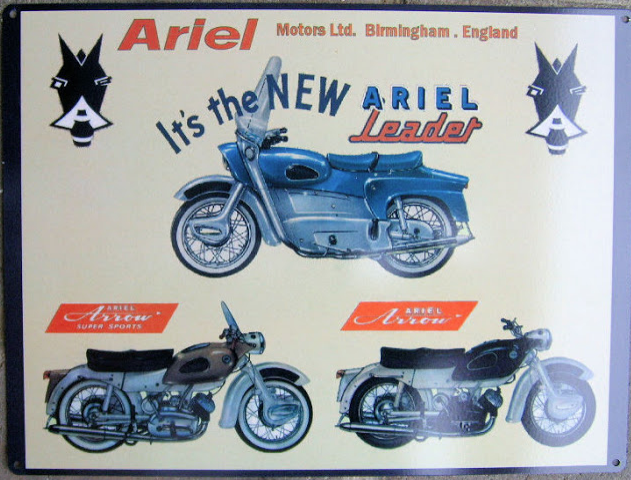
The New Ariel Leader
Even the wheels were used to help the illusion along, being smaller than usual on a motorcycle – in order to give a decent movement within the bodywork without increasing the bulk of the whole machine – but not so small that anyone could reasonably say that the result looked like a scooter. That, the design team realised, would be the kiss of death as far as motorcycle sales were concerned, and Page was canny enough to realise that there was little prospect of challenging Vespa and Lambretta’s stranglehold on that particular market.

In a sense, the Leader was the ‘car on two wheels’ dreamt of by hopeful designers, and it was close enough to that ideal, it initially seemed to demonstrate a real demand for such a device.
The Leader was launched in late 1958, and in 1959 it was voted the first ‘Machine of the Year’ by readers of Motor Cycle News, an extraordinary feat when you consider that the Triumph Bonneville was launched the same year, and the opposition included lusted-after machines like Gold Stars and Dominators.
For once a considerable number of motorcyclists put their money where their mouths were, and when the Leader was stripped down to make the even more motorcycle-like Arrow – itself voted the Machine of 1960 – sales soared to 1600 in one month. It was a remarkable achievement, but it didn’t last.

Ariel Leader - Ariel Arrow - Ariel Arrow Super Sport
The Leader’s demise is often blamed on its arrival in the marketplace almost coinciding with that of the affordable and trendy Mini car and van, and there might be some truth in that.
More importantly, though, it seems – even though motorcycle designers have often persuaded themselves that a motorist is a motorist is a motorist – car drivers, scooterists and motorcyclists are totally different breeds.

Ariel Leader Sales Poster
I suspect the Leader’s initial purchasers were mostly motorcyclists seduced by the idea of weather protection, but they were quickly disillusioned by the discovery that waterproofs were still needed to keep warm and completely dry. And when you added in the Leader’s quickly revealed shortcomings of uninspiring performance and brakes, plus its sometimes problematic starting, its demise was inevitable.
The Leader was quickly followed by the Velocette Vogue and by the DMW Deemster, both of which disappeared after achieving little success.
Half a century later it looks so modern a present-day motorist would probably ignore it unless he, or she, happened to notice its non-reflective number plates.
Many of the catalogued optional goodies where indicators (especially flash for the period), and help the modern image along, and they’re especially helpful now that many car drivers seem to interpret an outstretched arm as a challenge rather than a signal.

Ariel Leader optional Extras.

Ariel Leader Arrow Supersport Accessories

Ariel Leader Arrow Super Sports Specification
The panniers and luggage rack may show the first owner intended to seriously tour on his Leader, or they may have merely been embellishments, like the much sought-after, but totally useless, rear fender.

Ariel Leader Features

Ariel Leader indicator

Ariel Leader rear luggage carrier

Ariel Leader rear bumper
It starts easily and reliably, helped by the non-standard carburettor tickler fitted in the right-hand engine panel. The clutch is pleasantly light, but has a hair trigger action that needs caution when combined with an engine producing little low-down oomph. Gear selection is equally easy and reliable, despite the lever’s long movement.
The best thing about the Leader is you can quickly forget how unusual it is, and just treat it like a good example of a 1960s quarter litre motorcycle
The short list of criticisms confirms just how little was wrong with the machine when taken on its own terms. About 17,000 Leaders were made in their few years of production, but once the initial demand was satisfied, that was that. Some tentative attempts were made to develop it further, but in 1963 the assembly line was moved to the BSA factory where there was little interest in the machine, and production ceased in mid 1965.

25000th Ariel Leader
The Ariel Leader got close to showing it was possible to make the ‘motorcycle for everyman’, but in the end it actually proved that ‘everyman’ never existed.
Ariel Leader features
Two-tone colour schemes
Perspex windscreen wide enough to shield a rider’s hands from most of the elements and the wind-blast.
The pressed-steel leg-shields came as standard.
The drive chain and engine was enclosed in protective pressed-steel panels designed to keep the rider ‘oil-free’.
Extras included an :
Eight-day clock
A chrome rear bumper
A rear parcel carrier and colour-coded panniers (equipped with a set of rear indicators).
To keep production costs to minimum, most of the Leader’s bodywork, along with the unusual welded box-beam that acted as a frame, was built from pressed-steel panels. If not exactly attractive, the frame was stiff and sturdy—an essential requirement for producing a well-behaved motorcycle. The rear section of the body hinged to allow access to the rear wheel.
The steel petrol tank (2 ½ gallon) was rubber mounted. It was placed in the frame under the seat leaving the dummy tank as a storage compartment large enough to house a small crash helmet.

Ariel Leader Brochure
The Ariel Leader engine
The 250cc two-stroke engine with its 180-degree crank hung from the frame on three pressed-steel brackets.
To save weight, and presumably to cut production costs, the rear bracket doubled as an air-intake silencer chamber).
The parallel twin cylinders were made of cast iron and angled forward at 45°. This move decreased the overall height of the engine which made it possible to be mounted in a low position, thus bringing the centre of gravity closer to the ground and improving stability.
The engine case which contained the crank, four-speed Burman CP gear box and inner side of the primary chain housing was cast as a single light-alloy shell.
The cylinder head was also cast in light-alloy.
The engine proved to be reliable enough, provided that you kept your carburettor settings in check and didn’t starve the engine of lubricant. On the plus side, the engine could be dismantled without removing it from the frame.
A point to mention is that it's important to fit the Ariel Leader pistons the correct way around. Why? Because they have slightly offset gudgeon pins in Désaxé style. The Leader, however, isn't a true Désaxé engine in which the cylinders are offset in relation to the crank axis towards the direction of rotation thereby "biasing" the power stroke. In other words, a Désaxé engine, because its cylinders are offset, has the pistons either slightly ahead or slightly behind the crank centreline.
With the Leader, the cylinders are not offset. But the offset gudgeon pin has the same, or a similar, effect. Be warned when rebuilding.
The Leader was fitted with coil ignition and a Lucas alternator.
The rest of the electrics were fairly standard fare, but (according to some riders, and disputed by others) with unreliable switches. A six-inch headlight just bordered on the right side of adequate. The contact breaker assembly was dodgy too.
Ariel Leader Suspension and brakes

Ariel leader front Suspension and Brake

Ariel Leader Front Suspension

Ariel Leader rear suspension and brake
· The front suspension incorporated a trailing-link fork with two-way damping.
· The fork legs were encased in unconventional, golf-club shaped housings made from pressed-steel.
· The 16-inch wire wheels delivered a surefooted ride giving the Leader a distinct advantage over its small-wheeled scooter counterparts.
The wheels were supplied with whitewall tyres (still available) and quick-release, full-width hubs and drum brakes (6-inch x 1—1/8in).
· Both hubs and drums were originally manufactured from an aluminium alloy, but that changed by 1961 when both were made from cheaper, and heavier, cast iron—the change was said to be due to cracks developing in the original alloy fabrications.
Ariel Leader Handling and fuel economy
· On a whole, the Ariel Leader was a success—in terms of fulfilling its brief and initial sales, anyway. The bike handled exceedingly well.
· The top speed of 70mph (on later models almost 80mph) was impressive.
· The engine ran efficiently and could return 70mpg at 60mph.
· It looked like the Leader would conquer the market. So much so, that in 1960 Ariel (under the control of BSA, note) discontinued production of their four-strokes, putting all their efforts to the Leader and its offshoot un-faired models: the Ariel Arrow and the Arrow Super Sports (colloquially referred to as the Golden Arrow).
· It was a very bold and controversial corporate risk. But the times were changing, and old orthodoxies were crumbling. Cheap (ish) cars in the shape of the Austin Mini (1959) and the Ford Cortina (1962) were changing the shape of domestic transport in Britain. Something needed to be done to stop a diminishing market from imploding.
The Ariel Leader, on paper at least, looked as if it might throw the firm a lifeline and set a new biking (and for that matter, a new driving) trend. But despite the relative success of the model for the first few years of production, much of the public were confused and divided, and early hopes were soon dashed. Had the Leader been further developed in line with a four cylinder concept highlighting the possibilities of the design, the future might have been different (although the writing was clearly on the wall for the British motorcycle industry, and it was perhaps always a question of when, rather than if). But BSA, struggling to rationalise a monster company with too many arms and divisions, simply relinquished the Leader reigns and in 1965, the Ariel Leader and Ariel Arrow were discontinued.
Ariel Leader price and production figures
· There were, however, a few practical criticisms.
· The relatively minor ones included shoddy paintwork and rough/heavy gear-change with an unfortunate tendency to slip into neutral when not wanted.
· And the centre stand could "ground out" when riding two up.
· Another issue was that if you’d squinted at the engine and knew your European motorcycles, you couldn’t have missed the resemblance to the power unit used by German motorcycle firm, Adler. Just a coincidence? Certainly, Val Page and Bernard Knight were aware of a similar engine design by the German firm, Adler. But the differences are as great as the similarities, and the Leader should be viewed as an original concept rather than a copy.
· But the biggest issue was the price. Although the Leader was designed with production economy in mind, the initial cost of tooling (etc) brought the final purchase price to £209 11s 7d. And this was decidedly more expensive then an average scooter, and only barely cheaper then a price of many “fully-grown” motorcycles.
· Ariel built 18,347 Leaders
· 9,789 Arrows
· 6,217 Arrow Super Sports (Golden Arrow)
· And 844 of the smaller 200cc Arrows.
· Sales, incidentally, were hampered by a lack of interest in export markets, not least the USA which was geared largely towards the leisure end of the market, as opposed to the commuter end. As a consequence, the comprehensive weather protection offered by the Leader was hardly a selling point.
Ariel Leader colours
Admiralty Grey was the original main colour for side panels, leg shields, front fork, and front mudguard
With either Cherokee Red or Oriental Blue above.
Later bikes had a Dark Seal Grey option for the upper body.
In 1964, Leaders were available in an Ivory/Flamboyant Red livery
Ivory/British Racing Green
Ivory/Aircraft Blue.
Black was also optional, and we're advised that Red/Sky Blue was yet another colour choice.
Buying an Ariel Leader
Aside from a basic visual inspection—such as checking for crash damage, rust, and obvious missing parts—
Buyers should ensure that the engine mounts are in good condition. Repairs here will quite probably require a complete frame strip. So pay special attention.
Check too that the bike is an easy and regular starter. Poor starting could be due to carburettor issues (Amal 375, 7/8th inch choke) or ignition issues (6v coil/alternator), which are easily remedied.
Or it could be due to blown crankcase seals—which are a little more complicated to sort out.
Bikes in regular use invariably fare better than bikes that spend most of their time idle in the garage, so ask intelligent questions about usage and history. And don't be deterred by a scruffy hack. These are often in good tune and reliable.
The bottom end of an Ariel Leader can, remember, be stripped with the engine in situ (using the correct puller to split the flywheel halves), so don't be too daunted by the prospect of a rebuild (as long as the asking price is right.
Check exhaust baffles for heavy coking. These can be cleaned or replaced, and complete silencers are available—albeit a little pricey. But running on a modern 35:1 oil/petrol mix (as opposed to the original 25:1) will significantly cut maintenance.
Riding the Ariel Leader
They're surprisingly good fun. That's the bottom line.
Of course, a lot of that fun depends upon how much your head's been turned by the styling, because you certainly can't escape that. There's no other British bike that's quite like a Leader.
The weight distribution and balance is fairly good, even when riding two up.
But the brakes are struggling at pretty much any speed.
Owners occasionally fit other brakes from other bikes, particularly at the front, but the loss of originality will hit you hard in the pocket. Only top Leaders sell for top money, and the braking is manageable once you adjust to it.
Otherwise, the controls are light and easy. Steering is light and steady. The suspension is adequate to good.
The weather protection is the unique selling point if you're planning to use a Leader as a daily ride, and because it has so much presence on the road, motorists tend to be a little more generous about sharing space.
But take care, because there are still plenty of rubberneckers out there anxious to get a closer look.
The performance is acceptable, by modern standards. But you'll notice a real difference when carrying a passenger. There simply isn't much in reserve. So factor that in.
Cruising at 50-55mph is realistic and comfortable.
Acceleration is fairly sprightly—unless you're used to modern two-strokes.
But it's still a viable classic, and one that you really could comfortably tour upon.
Prices fluctuate significantly as these bikes slip into and out of fashion. Which is appropriate really because the world always was ambivalent about these wonderful two-strokes.
From the outset, they were as right as they were wrong. They were always both stylish and gaudy anachronisms right off the drawing board owing much of their philosophy to the early days of motorcycling before the conventions had been established.
We like them plenty, not only as a bold statement of British engineering eccentricity, and not only as a reminder of the post-war optimism that died a sour death some time around the 1970s, but also because they're as much quirksome as irksome and that they challenge biking conventions.
Ride with pride. Ariel Leaders are simply cool.

Ariel Leader Dashboard
1961 Ariel Leader specifications
Type: Air-cooled two-stroke parallel twin
Capacity: 247cc (250cc)
Bore & Stroke: 54mm x 54mm
BHP: 17.5 @ 6400rpm
Compression ratio: 10:1
Transmission: 4-speed, multi-plate clutch
Brakes: 6-inch single leading shoe drums front and rear
Electrics: Lucas alternator, coil ignition, 6 volt
Front suspension: Trailing link fork
Rear suspension: Swinging arm, twin shock absorbers/dampers
Wheels: 3.25 x 16-inch front & rear
Weight: 320lbs (dry)
Maximum speed: 70mph (approximately)
Ariel Golden Arrow
This was a cheaper, stripped Leader produced from 1959 and was developed into the Golden Arrow 'sport' version in 1961.
A sister-machine designated Ariel Arrow 200 – with a smaller capacity of 200 cc, achieved by reducing the bore to 48.5 mm from 54 mm whilst retaining the same stroke was available from 1964 to bring it into a lower tax band and benefit from lower UK rider insurance premiums.
In his 1964 Motor Cycle road test, Bob Currie reported good performance, with an absolute top speed – with "rider lying flat, of course" – of 74 mph and a cruising speed which could be held at 60 mph.
The bike had the usual Arrow ivory background colour, but with the tank and chaincase finished in either 'aircraft' blue or British Racing Green, and tank badges denoting 'Arrow 200'.
After the Ariel factory closure, in 1967 Ariel marketed its last motorcycle, the Arrow 200 produced for a time by BSA.
In 1960, a prototype Arrow with a four-stroke 349 cc twin-cylinder engine was made to sell alongside the Ariel Leader.
The budget engine, designed by Val Page to do 75 mph (121 km/h), was canted to fit the Arrow frame. Although it was thought the initial 18 bhp (13 kW) power output could have been increased to 24 bhp (18 kW), development money ran out and the project was dropped.
Ariel could not compete against Japanese imports. The Ariel factory closed in 1965, although the name remained under BSA to produce Ariel Arrows until 1967 and a commercially unsuccessful 49 cc banking trike named Ariel 3 in 1970.
To find out more fun Future Facts by clicking our Blogs below……….!!! Please Share …..
Ghostbuster - Ecto 1
https://www.sandstoneproductions.co.uk/blogtothefuture/2021/3/31/ghostbusters-ecto-1
Cars of Back to the Future
https://www.sandstoneproductions.co.uk/blogtothefuture/2021/2/10/the-cars-of-back-to-the-future-55-
Back to the Future Fashion
https://www.sandstoneproductions.co.uk/blogtothefuture/2021/2/19/back-to-the-future-fashion-te2yx
Ariel Leader
https://www.sandstoneproductions.co.uk/blogtothefuture/2021/2/17/ariel-leader
Back to the Future - Hill Valley History
https://www.sandstoneproductions.co.uk/blogtothefuture/2021/2/2/hill-valley-history-jxrr4
Back to the Future Gadgets and Trends we have in 2021
Doc Browns Biography and the History of his DeLorean Time Machine
Marty McFly Biography also featuring Biff, George, Jennifer, Loranine
Back to the Future - Hill Valley History
https://www.sandstoneproductions.co.uk/blogtothefuture/2021/2/2/hill-valley-history
Back to the Future - Detailed storyline
Back to the Future - How to generate 1.21 Giggawatts / Jiggawatts with Mr Fusion
What is a Fat Bike ? And where did the idea of Fat Bikes come from ?
https://www.sandstoneproductions.co.uk/blogtothefuture/2021/1/10/fat-bike-what-is-a-fat-bike-history
The Time Paradox explained - Back to the Future
The Sinclair C5
https://www.sandstoneproductions.co.uk/blogtothefuture/2021/1/9/sinclair-c5-
Mini Jeep Mini Review
https://www.sandstoneproductions.co.uk/blogtothefuture/minicoolsterjeepreview
Hoverboards - Back to the Future
https://www.sandstoneproductions.co.uk/blogtothefuture/2020/12/13/hoverboards-
How does the Time Machine work - Back to the Future
https://www.sandstoneproductions.co.uk/blogtothefuture/2020/11/22/how-does-the-time-machine-work
The DeLorean Motor Company - What did it fail ? Or did it ?
https://www.sandstoneproductions.co.uk/blogtothefuture/2020/11/22/whydiddeloreanmotorcompanyfail
The DeLorean Motor Company - History
https://www.sandstoneproductions.co.uk/blogtothefuture/2020/11/22/deloreanmotorcompany
The Flux Capacitor - Back to the Future
https://www.sandstoneproductions.co.uk/blogtothefuture/fluxcapacitor
Is Time Travel Possible ? And what would it take ? Back to the Future
https://www.sandstoneproductions.co.uk/blogtothefuture/istimetravelpossible