
Sinclair C5 Hire
Back to the Future of 1985 - Electric Transporation - EV of the 80’s !!!
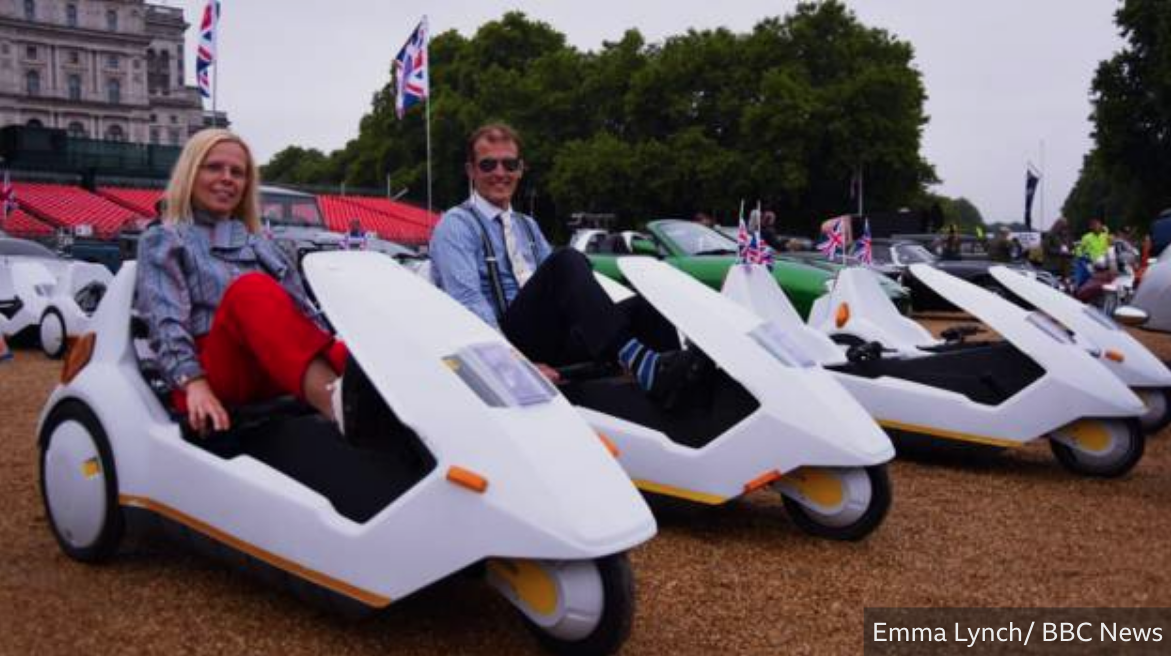
Celebrating 80’s at the Platinum Queens Jubilee Celebrations
Sinclair C5 Hire UK
Do you remember the future as it was imagined in 1985?
The Sinclair C5 wasn't just a vehicle. It was a vision of tomorrow.
Now you can bring that piece of British innovation and nostalgia to your next TV production, film, commercial, exhibition or special event.
Our original 1985 Sinclair C5s are available for hire throughout the UK, complete with experienced operator support if required.
For fans of retro technology, British motoring history and 1980s culture, few vehicles create as much interest and conversation as the iconic Sinclair C5.
Ahead of its time then. Unforgettable today.
GOOGLE REVIEWS - Customer Review⭐⭐⭐⭐⭐

The Sinclair C5
Introducing the Sinclair C5
The Sinclair C5 is a small one-person battery electric velomobile, technically an "electrically assisted pedal cycle".
It was the culmination of Sir Clive Sinclair's long-running interest in electric vehicles. Although widely described as an "electric car", Sinclair characterised it as a "vehicle, not a car".
Powered by a 12-volt lead acid battery, the C5 had a claimed range of 20 miles - enough to cover many people’s commutes to work - but it could only travel at legal 15mph using its Hover 250 Watt Motor
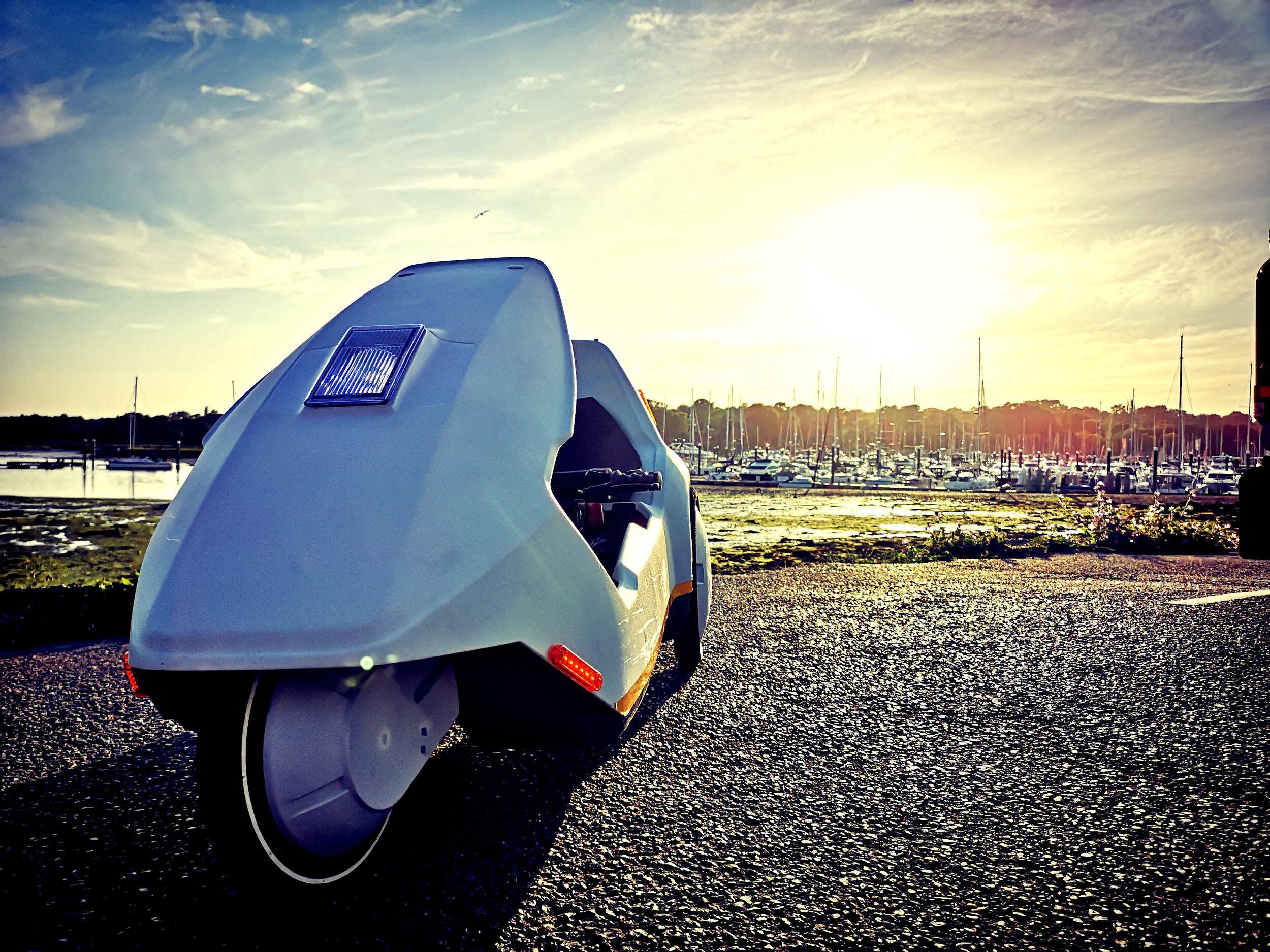
Sinclair C5 Technical Specification
Technical Specification
1985 Price : £399 (£428 delivered mail order)
Predicted sales : 100,000 in the first year
Length : 1.74 m
Total height : 80 cm
Electric motor : 250 W (0.34 hp) permanent magnet motor by Polymotor
Battery : 12 V lead-acid battery
Range : 20 miles (32 km)
Luggage : 28 Litres
Manufacturer : Sinclair Vehicles
Project cost : £12 Million
Requirements : No licence, insurance or tax required, ridden by anyone over 14
Made : 14,000
Sold : 5,000
The Sinclair C5 Project Timeline
1979 First concept
1980 British government abolished road tax for electric vehicles
1983 March Sir Clive Sinclair sells some of his share in Sinclair Research to raise £12 Million and Forms Sinclair Vehicles. The Hoover Company were contracted to manufacture the C5 at their plant in Merthyr Tydfil
1983 Introduced legislation for ‘electrically-assisted pedal cycles’. New Legislation was Introduced to allow 2/3 wheel vehicles with a maximum of 15mph on U.K Roads
1983 10th January Sinclair C5 was launched with mixed reviews
1985 August Hoover stop producing the C5 as Sinclair vehicles gets into difficulties. Large
Quantities of C5’s remain unsold
1985 October Sinclair Vehicles is put into receivership
1992 Sinclair Zike is released, sold 2000 unit and production ended 6 months later
2011 July Sinclair X-1 possible successor to the C5 was meant to go on sale for £595.

Sinclair C5 Hire
Sinclair C5 Hire UK – A True 1980s Icon
Own a piece of British motoring history at your next event, production or exhibition.
We have two original Sinclair C5s available for hire throughout the UK, creating instant nostalgia, conversation and media interest wherever they appear.
🎬 TV Programmes & Documentary Features
🎥 Film & Commercial Productions
⭐ Conferences, Exhibitions & Corporate Events
🎉 1980s Themed Events & Retro Festivals
📸 Promotional Campaigns & Product Launches
🏛️ Museums, Heritage Displays & Public Exhibitions
Whether you're recreating the 1980s for the screen, producing a documentary on British innovation, or looking for a unique display piece that guests will instantly recognise, the Sinclair C5 delivers the perfect blend of nostalgia, curiosity and retro charm.
✅ Original 1985 Sinclair C5s
✅ Professional On-Set Support Available
✅ Experienced Operator Available To Drive On Camera
✅ Flexible Half-Day & Full-Day Hire Packages
The future may not have arrived as planned...
But the Sinclair C5 remains one of Britain's most unforgettable inventions.
The driver sits in a recumbent position in an open cockpit, steering via a handlebar that is located under the knees. Inside the C5 a Pod displays Battery power status and ‘Load’ via a series of LED’s of Green amber and Red. A ingnition style key powers up the C5. Front and rear brake levers are positioned on the handlebar along with a button for the horn and indicators. Front and rear lights are turned on via a switch just under the seat
At the rear of the vehicle is a small luggage compartment with a capacity of 28 litres (1 cu ft)
The C5 even had accessories :
These included indicator lights, mirrors, mud flaps, a horn, and a "High-Vis Mast" consisting of a reflective strip on a pole, designed to make the C5 more visible in traffic. Sinclair's C5 accessories brochure noted that "the British climate isn't always ideal for wind-in-the-hair driving" and offered a range of waterproofs to keep C5 drivers dry in the vehicle's open cockpit. Other accessories included seat cushions and spare batteries.
While Sinclair optimistically planned for a series of EVs including larger spin-off versions of the C5 capable of up to 80mph, the writing was on the wall. Within months of the C5’s launch production was halted and retailer These included indicator lights, mirrors, mud flaps, a horn, and a "High-Vis Mast" consisting of a reflective strip on a pole, designed to make the C5 more visible in traffic. Sinclair's C5 accessories brochure noted that "the British climate isn't always ideal for wind-in-the-hair driving" and offered a range of waterproofs to keep C5 drivers dry in the vehicle's open cockpit. Other accessories included seat cushions and spare batteries.Comet was trying to sell off unsold C5s for £139.99 - a huge discount on the original £400 asking price. Sinclair Vehicles went bust the same year.
It’s quirky design was inspired by new regulations at that time, allowing the C5 to be driven on British roads without a license. Which to this day in 2021 is able to be driven legally used on UK roads.
Of the some 14,000 produced, only about 5,000 of them sold in ten months before production ceased
Sinclair C5 News !!!

Sinclair C5 - Queen Platinum Jubilee Pageant Sinclair C5 BBC News

Contact us today
Sinclair C5 FAQ’s
1. What is the Sinclair C5?
The Sinclair C5 is a one-person electric tricycle launched in 1985 by Sir Clive Sinclair. Although often called an electric car, Sinclair described it as a new type of personal electric vehicle.
2. Who invented the Sinclair C5?
The C5 was created by Sir Clive Sinclair, the British entrepreneur behind the ZX Spectrum and ZX81 home computers.
3. When was the Sinclair C5 launched?
The vehicle was officially launched on 10 January 1985 amid enormous media attention.
4. Was the Sinclair C5 an electric car?
Not officially. It was legally classified as an electrically assisted pedal cycle, although most people referred to it as an electric car.
5. How fast could the C5 go?
The top speed was limited to 15 mph (24 km/h), in line with UK regulations governing electrically assisted vehicles.
6. How far could a C5 travel on a charge?
The original C5 had a claimed range of approximately 20 miles (32 km) under ideal conditions
7. Did the C5 have pedals?
Yes. The C5 included bicycle-style pedals to help the rider on hills and extend battery range.
8. Why was the rider seated so low?
The recumbent seating position was chosen for efficiency and aerodynamics, but many people felt vulnerable sitting so close to the road.
9. Was the C5 safe?
Safety concerns were one of the biggest criticisms at launch. Many journalists worried the low vehicle was difficult for motorists to see, although some safety assessments were less critical than the press coverage suggested.
10. Did the C5 have a roof?
No. The rider sat completely exposed to the weather, although weather accessories were offered.
11. What battery did it use?
The Sinclair C5 used a 12-volt lead-acid battery powering a 250-watt electric motor.
12. How much did a Sinclair C5 cost when new?
The launch price was approximately £399 to £400 in 1985.
13. Why did the Sinclair C5 fail?
A combination of limited range, low speed, negative press, weather exposure, safety concerns, and public misunderstanding led to poor sales.
14. How many Sinclair C5s were made?
Approximately 14,000 units were produced during 1985.
15. How many were actually sold?
Only about 5,000 units were sold before Sinclair Vehicles collapsed.
16. Did the C5 bankrupt Sinclair?
Not Sir Clive personally, but the project led to the failure of Sinclair Vehicles, which entered receivership in 1985.
17. Was the C5 ahead of its time?
Many historians and EV enthusiasts believe so. The C5 anticipated today's interest in electric mobility by decades, although the technology and market were not ready in 1985.
18. Can you still buy a Sinclair C5?
Yes. Surviving examples regularly appear for sale through collectors, enthusiasts, and specialist auctions.
19. Are Sinclair C5s valuable today?
Yes. Once seen as a commercial failure, the C5 has become a sought-after collector's item, with values often far exceeding the original retail price.
20. Why is the Sinclair C5 still famous?
Because it remains one of Britain's most ambitious and controversial technology products—a pioneering electric vehicle that failed commercially but became a cultural icon.
Bonus Question
Was the Sinclair C5 the world's first electric vehicle?
No. Electric vehicles had existed for over a century before the C5. What made the C5 special was its attempt to bring affordable, mass-market personal electric transport to ordinary consumers.
Love it or laugh at it, the Sinclair C5 remains one of the most famous electric vehicles ever built.
How fast does a Sinclair C5 Go ?
15.5 Mph (24 km/h)
The Sinclair C5 Project Timeline
1979 First concept
1980 British government abolished road tax for electric vehicles
1983March Sir Clive Sinclair sells some of his share in Sinclair Research to raise £12 Million and
Forms Sinclair Vehicles. The Hoover Company were contracted to manufacture the C5 at their plant in Merthyr Tydfil
1983 Introduced legislation for ‘electrically-assisted pedal cycles’. New Legislation was
Introduced to allow 2/3 wheel vehicles with a maximum of 15mph on U.K Roads
198310th January Sinclair C5 was launched with mixed reviews
1985August Hoover stop producing the C5 as Sinclair vehicles gets into difficulties. Large
Quantities of C5’s remain unsold
1985October Sinclair Vehicles is put into receivership
1992 Sinclair Zike is released, sold 2000 unit and production ended 6 months later
2011July Sinclair X-1 possible successor to the C5 was meant to go on sale for £595.
Sinclair C5 Myths busted !
One of the long-held myths about the motor found in the C5 was that it was also used in washing machines – this was emphatically not the case. However, Hoover engineers were trained to service the C5 as Sir Clive’s mobility project for the masses was also built in the company’s factory in Merthyr Tydfil, south Wales.
The little white wedge easily slotted into the category of vehicle it was designed for. With a 45kg weight with battery, it undercut the imposed restrictions by 15kg. The battery was a ‘deep discharge’ unit, which meant it could be charged hundreds of times with no noticeable loss of performance. Or that was the theory anyway. The C5 is rear-wheel drive, too – just like all the best driver’s cars! – with the left-hand rear wheel powered by the electric motor.
What motor does a Sincliar C5 use ?
Due to the legislation it was designed for, the C5 was limited in both performance and weight. Motor output was stifled, too: a 250-watt ceiling was applied to vehicles in the ‘electrically-assisted pedal cycle’ category.
Sinclair’s engineers took a 12V DC, 250W, 29A, 3,300rpm permanent magnet motor supplied by Italian company Polymotor to provide power for the C5. Fun Fact Polymotor also manufactured washing machines.
Aimed at those who travelled alone, either in cars, on their bicycles or on public transport. Sir Clive had dabbled in electric vehicle research since the early 1970s, but the 1983 legislation fitted in perfectly with the C5’s technical make-up. And so it was that, two years later, arguably the UK’s most recognised electric vehicle was born.
What exactly is a Sinclair C5 ?
The only way of buying one was by mail order – the C5 arrived in a cardboard box, delivered to your door, an option which wasn’t available to other small ‘cars’.
The most conventional four-wheeled rival was the 998cc Austin Mini City E, which was almost ten times the price – at £3,298.
Other contemporary competition included the also-three-wheeled 850cc, 73.3mpg Robin Rialto 2. The larger three-wheeler promised ‘A Car You Can Afford to Get Excited About’, according to the press ads. And buyers obviously believed them, as it had a 12-month waiting list when new.
However, if we’re talking innovative disasters, the Sinclair C5 is joined by the equally cult-ish DeLorean DMC-12 as one of the biggest transport failures of the 1980s.
Do You need a drivers license for a Sincliar C5 and What its like to drive ?
Maybe two of the right words to describe the C5 driving experience are ‘terrifying’ and ‘fun’. Sitting above the handlebars on the thinly-padded seat, your arms reach down past your bent legs – which can, and will have to, pedal at some point – while your feet rest on the pushbike-like Sinclair-branded and grooved pedals.
You insert the ignition key into the master security switch and turn on the power.
Motor load and battery condition are shown by two LED graph displays under the aerodynamic front cowling.
Push the left-hand handlebar starter/accelerator button and you’re away.
Ignore the twisted ‘mirror’ logic, which makes you think you want to steer the way you don’t want to go, and instead relish the ‘acceleration’ offered by that 250W motor.
Braking is controlled either by un-pressing the handlebar accelerator button or by squeezing the bike-like triggers. It also has a ‘handbrake’ feature where it locks the back brake on, so leaving on inclines is not a problem.
Unbelievably, the C5 has front calliper and rear drum brakes, so comes to a stop quickly and safely, if not the most elegantly. With a top speed of 15mph, Sir Clive Sinclair’s baby doesn’t sound fast, but believe us, it feels it.
As a driver, you’re so exposed to both the elements and the passing traffic that bowling along at speeds of up to half of the legal urban limit feels anything but pedestrian. Which, incidentally, is another type of road user you have to watch out for?
Sinclair claimed that the C5 had the ‘same seat height’ as a family car. That was true if that car was originally from 1959 and was called a Mini. And despite Lotus being involved with the project, and Sinclair’s claims of ‘extraordinary manoeuvrability’ when it was new, the C5 certainly doesn’t handle like a sports car. It does share a low centre of gravity with the legendary cars from Hethel, but that’s where any similarities end.
Reliability and running costs Many C5 owners reported unit burn-outs as the permanent magnet motor struggled to cope with any form of gradient; pedal assistance was very often required. Also, C5s suffered the indignity of running aground over speed bumps, even small ones. The single gear was also a cause of complaint. Plus, there was no reverse gear, so every backwards turn turned into a multi-point negotiating nightmare. Sinclair claimed that the C5 could be driven for five miles on one penny’s worth of electricity, or 1,000 miles for the contemporary price of a gallon of fuel. The official range on a single charge was stated to be 20 miles, but most owners reported half that in cold conditions. The 15kg battery could be charged to full capacity from flat in eight hours – much longer than today’s all-electric cars. Some enterprising modern-day owners of C5s swap the old lead acid battery for lightweight Lithium-ion replacements for increased range and better reliability. One owner reports 45 miles of range from his 60Ah lithium-ion battery, which weighs half as much as the original.
Can I drive a Sincliar C5 everyday ?
You could, but we wouldn’t recommend it. The C5 feels tiny among car-sized traffic flows. On the plus side, the C5’s turning circle was two-thirds of the original Mini’s.
How much should I pay?
We’ve seen C5s on well-known auction sites for around £500. ‘Project’ C5s can start at £275, while at the opposite end of the scale, fully working and ‘restored’ C5s can be had for £800. Where a boxed ‘new’ one attracts around £1500
Sincliar C5 Buying tips
Used handlebars are priced at around £30 online, and a complete set of wing mirrors can fetch £200. Replacement used motors can start at £55. There’s a market in the 3D printing of Sinclair C5 parts
Should I buy a Sincliar C5 ?
If you’re a culture junkie and the idea of owning a piece of motoring history appeals, then yes, undoubtedly. Even if it will never go very far.
The C5 is such a recognisable and symbolic piece of motoring folklore, due to both its promise and failure, that it will always be a talking point.
If you’re lucky, you might even find one with all the period accessories, such as a booster cushion for those short of leg, a ‘High-Vis Mast’ (basically a metal pole with a reflective flag atop it), a second battery, side screens for increased weather protection, and a tonneau cover.
If you really want to fit in, try also to find the period ‘designer’ clothing (very stylish 1980s drama Howards’ Way), the ‘weather cheater’ poncho, and the car-like C5-branded mud flaps, turning indicator kit, and wing mirrors.
The C5 was never designed for long distances, and its limitations show when its comes to practicality.
More 80’s facts ….
The Sinclair C5 was launched at Alexandra Palace on 10 January 1985
Assembled was a throng of journalists included friend of MR and ex-Top Gear presenter, Sue Baker.
With a suggested 9,000-17,000 C5s finding homes in 1985, Sir Clive Sinclair claimed that his plastic fantastic dream was the UK’s best-selling electric car until the more modern and four-wheeled Nissan Leaf overtook it in 2011 with sales of 20,000.
Sinclair was in the mood for more electric vehicle creation in 1992, when the Zike electric bike was released. Like the C5, production lasted just six months – and around 2,000 were sold.
Nineteen years later Sir Clive was at it again with the X-1, an electric ‘sit-down’ cycle, which was to be sold for £595.
However, it never reached production and the cash he needed to develop his four-seat electric car vision never was generated.
Why did the Sinclair C5 fail ?
The aforementioned weather protection (or lack of) is just one issue.
Another is luggage space. The promotional videos of the time boast of a ‘large capacity boot’, but if you have more than 28 litres of luggage, then the flip-out ‘boot’ on the back of the driver’s seat will be of little use. It’s perfect for your poncho or Pac-A-Mac, though.
Visibility and Safety : It was very low to the ground, with larger vehicles struggling to notice this small vehicle on the road, leading to major safety concerns.
The height of the rider was so low that you were exactly in line with exhaust pipes
Weather Exposure : The shell offered no protection from the rain or cold, even though there was a side panels option available
Sluggish Performance : The 250w electric motor forced riders to assist it by pedaling, and with Battery technology at the time the range was poor
What kind of Battery was fitted to the Sinclair C5?
It was a 12 Volt lead-acid battery coupled to a 250 Watt Electric Motor.
How Far could a Sinclair C5 travel on a single charge ?
Sincliar claimed 20-mile range (32km) This proved highly optimistic in read life conditions. It depended on Terrain, rider weight, and if the ‘Push and coast’ method was used to save battery.
How Many Sinclair C5 were made ?
Production figures show around 14,000 units were manufactured. Over 1/3rd went unsold and fell into the hands of receivership.
Where were Sinclair C5’s built ?
Assembly took place at the Hoover Factory in Merthyr Tydfil, Wales
Sinclair C5 Hire UK | Britain's Iconic Electric Vehicle Experience
A True British Icon
Looking for Sinclair C5 hire in the UK? Sandstone Productions offers the opportunity to showcase one of Britain's most famous and innovative vehicles at your event.
Launched in the 1980s and instantly recognisable today, the Sinclair C5 remains a symbol of British innovation, technology and retro culture, making it a fascinating attraction for guests of all ages.
Why Hire a Sinclair C5?
Original 1980s British icon
Rare and unique event attraction
Ideal for technology and innovation displays
Fantastic conversation starter
Perfect nostalgic photo opportunity
Great for exhibitions and promotional events
Professionally displayed and transported
Perfect For
Retro and 1980s themed events
Corporate promotions
Technology exhibitions
Innovation showcases
Museums and heritage displays
Film and television productions
Trade shows and conventions
Educational and engineering events
Frequently Asked Question
Can I hire a Sinclair C5 for an event?
Yes. Our Sinclair C5 is available for hire nationwide and is ideal for exhibitions, promotional events, television productions, 1980s themed experiences and technology showcases.
Nationwide Sinclair C5 Hire
If you're searching for Sinclair C5 Hire UK, Hire a Sinclair C5, 1980s Vehicle Hire, Retro Event Entertainment, British Technology Displays or Unique Event Attractions, Sandstone Productions can provide a memorable addition to your event.
Celebrate British Innovation
Few vehicles capture the spirit of British invention quite like the Sinclair C5. Whether you are creating an 80s themed event, technology exhibition or nostalgic display, the Sinclair C5 is guaranteed to attract attention and spark conversation.
Contact Sandstone Productions today to check availability and receive a personalised quotation.